At North Sydney Plunge Pools, we specialise in building lap pools for tight-access sites and narrow backyards across North Sydney. We understand local challenges like sandstone, limited space, and strict council rules. Our team designs pools that fit precisely, function well, and meet all NSW compliance requirements, helping you create a private oasis within a limited footprint.
In this guide, you will learn how lap pool builders design for narrow blocks, the best layouts and features, approval pathways in Sydney, costs, common mistakes, and how to choose the right builder for your project.
What Is the Best Pool Design for Narrow Sydney Blocks?
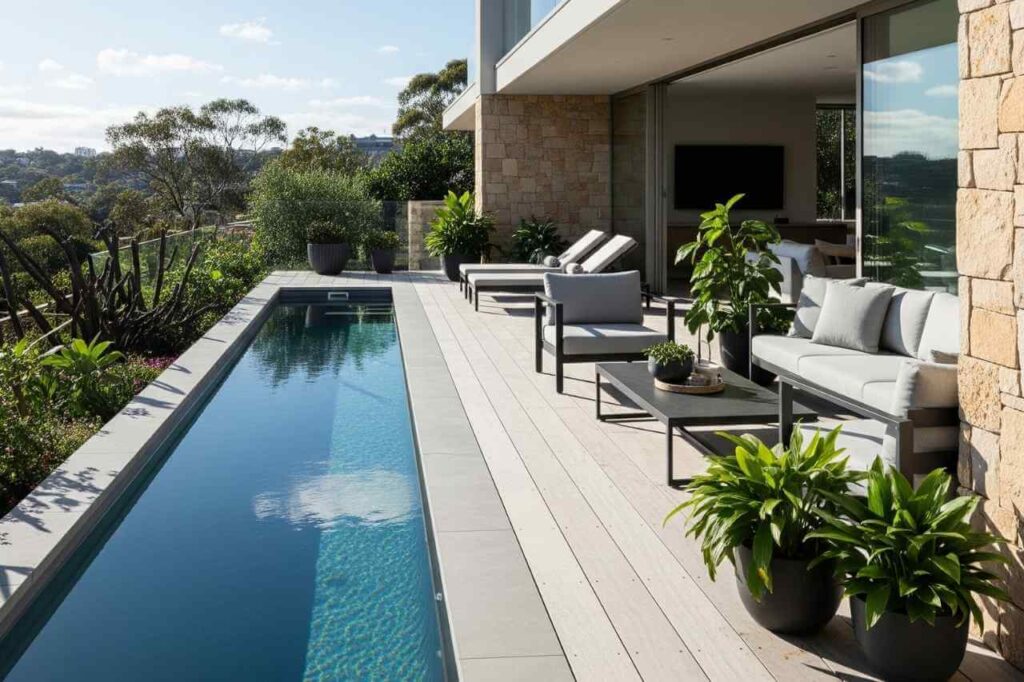
The best swimming pool design for narrow Sydney blocks is a lap pool.
It is long, slim, and built to run along a fence, boundary, or side of the house. This design uses length instead of width, making it ideal for tight backyards with limited space.
This makes it ideal for small backyards where width is limited, but length is available, especially when planning a compact pool solution.
Why lap pools work best
Lap pools are designed for space efficiency and function. In Sydney, where many homes have narrow lots, terrace layouts, or tight side access, this shape works naturally with the land.
Key benefits:
- Slim width (2–3 metres) keeps the footprint compact
- Long length (6–15 metres) allows full swimming and exercise
- Fits along boundaries like fences or house walls
- Keeps the yard usable for seating, landscaping, or entertaining
- Works with tight access sites common in Sydney suburbs
This is why many Sydney pool builders recommend lap pools for small backyard design ideas and narrow lot homes.
Typical lap pool size
| Feature | Range |
| Width | 2.0m – 3.0m |
| Length | 6.0m – 15.0m |
| Depth | 1.2m – 1.5m |
Who Lap Pools Suit
Lap pools are ideal for:
- Narrow backyards in Sydney (terrace homes, duplexes, compact lots)
- Fitness-focused homeowners who want a swim lane at home
- Small families needing a simple and usable pool
- Property investors want a strong visual appeal without losing space
They are also popular in inner-city suburbs like Surry Hills, Newtown, and North Sydney, where outdoor living and a functional outdoor space still matter.
How Do Lap Pools Make Small Backyards Feel Bigger?
Lap pools make small backyards feel bigger by keeping the layout clean, open, and easy to see across the pool area.
Key design tricks
- Glass fencing → keeps views open
- Light-coloured finishes → reflect light and brighten space
- Large tiles → fewer lines, less visual clutter
- Simple layouts → cleaner look
- Vertical plants → save space and add privacy
Thoughtful planning of the Deck and surrounding materials plays a big role in visually expanding the space.
What to Avoid in Small Backyard Pool Design
Avoid anything that breaks visual flow or adds clutter when making your pool area feel larger:
- Dark colours → make the space feel smaller and heavier
- Solid fences or walls → block views and close in the yard
- Too many materials → creates a busy, fragmented look
- Over-designed features → disrupt clean lines and openness
If you can see across the space, it feels bigger. Clear sightlines, minimal breaks, and consistent pool finishes are the key.
How Are Lap Pools Designed and Built on Narrow Blocks?
Lap pools on narrow Sydney blocks are designed with smart layouts, tight access planning, and strong engineering to fit limited space safely and ensure long-term performance.
1. Layout and positioning
- Long, straight pool design
- Placed along the boundary of the house
- Frees up the rest of the yard
2. Access and construction
- Crane lifts if no side access
- Small machines for tight spaces
- Concrete pools built on-site with built-in structural support
3. Engineering requirements
- Soil testing (often sandstone)
- Structural reinforcement
- Drainage systems
- Retaining walls for slopes
4. Compliance planning
- Pool fencing rules
- Boundary setbacks
- Approval pathway (CDC or DA) to keep the build pool safe
Fit the pool to the block first, then add features like a Spa if space allows.
Why Are Sydney Blocks Hard for Pool Builds?
Sydney blocks are hard for pool builds because of sandstone, slopes, tight access, and strict council rules.
These factors increase cost and require proper planning, especially for any pool project in a confined site.
Common challenges
- Sandstone → hard to dig
- Slopes → need retaining walls
- Tight access → may need cranes
- Strict rules → fencing and approvals
The tighter the block, the more planning you need.
CDC vs DA Approval: Which Is Faster?
CDC is faster. DA is more flexible.
A Complying Development Certificate (CDC) is usually approved in 2–4 weeks, while a Development Application (DA) can take 6–12+ weeks, depending on council and site complexity.
CDC (fast approval)
- 2–4 weeks
- Must follow strict rules
- Best for simple designs
DA (flexible approval)
- 6–12+ weeks
- Allows custom designs
- Needed for narrow or complex sites
Simple design = CDC. Complex site = DA.
How Long Does It Take to Build a Lap Pool?
Building a lap pool on a narrow Sydney block usually takes 10 to 20+ weeks total, depending on site conditions and whether it’s a new build or a pool renovation.
Timeline breakdown
- Design: 1–3 weeks
- Approval: 2–12+ weeks
- Build: 6–10 weeks
Delays can come from
- Sandstone excavation
- Tight access
- Approval changes
Good planning makes building faster.
Lap Pool vs Plunge Pool vs Spool
The best option depends on your block size and how you will use the pool, especially if you want year-round usability.
| Type | Best For | Space |
| Lap Pool | Swimming + fitness | Long blocks |
| Plunge Pool | Cooling + relaxing | Small yards |
| Spool | Relax + heated use | Very tight spaces |
Match the pool to your block shape first.
Boundary vs Central Pool Layout
Boundary pools work best for narrow blocks and help maximise the usable outdoor area.
Boundary layout (best choice)
- Runs along the edge
- Saves space
- Keeps the yard usable
Central layout (not ideal)
- Sits in the middle
- Wastes space
- Feels cramped
Build along the edge, not the centre.
Concrete vs Fibreglass Pools
Concrete pools are better for narrow blocks due to flexibility and durability.
Concrete pools
- Built on-site
- Fully custom
- Best for tight access
Fibreglass pools
- Pre-made shell
- Faster install
- Needs good access
Simple rule: Tight access = concrete.
What Common Mistakes Increase Pool Costs and Cause Delays?
Most problems come from poor planning and ignoring site limits, particularly in the pool industry, where tight sites require precision.
Common mistakes
- Choosing the wrong pool type
- Ignoring access
- Poor layout design
- Skipping engineering
- Not planning fencing early
Cost blowout causes
- Sandstone excavation
- Crane hire
- Design changes
- Approval issues
Plan everything early.
How Much Does a Lap Pool Cost on a Narrow Block?
A lap pool on a narrow Sydney block usually costs $60,000 to $120,000+.
The tighter the site, the higher the cost, but smart planning ensures your pool remains efficient and adds long-term value—this planning also ensures your pool integrates seamlessly with the home.
Cost breakdown
| Item | Cost |
| Pool shell | $35k – $70k |
| Excavation | $5k – $25k+ |
| Plumbing | $8k – $15k |
| Finishes | $10k – $25k |
| Fencing | $3k – $10k |
What increases cost
- Tight access
- Sandstone
- Larger pools
- Extra features
The tighter the site, the higher the cost.
Is a Lap Pool Worth It on a Narrow Block?
Yes, if it fits your space and you will use it often, creating a relaxing backyard retreat without sacrificing functionality.
When is it worth it
- You swim regularly
- You have a long, narrow yard
- You want better outdoor use
When it is not
- Space is too tight
- You will not use it
- It removes usable yard space
If you use it often, it is worth it.
How to Choose the Right Pool Builder
Choose a builder with experience in narrow Sydney blocks and a strong understanding of the pool industry and site-specific challenges.
What to look for
- Proven narrow block projects
- Strong engineering knowledge
- Understanding of approvals
- Clear pricing
- Access planning experience
Red flags
- No similar projects
- Generic designs
- Unclear costs
If they do not understand your site, they cannot design the right pool.
Conclusion
The best way to maximise a narrow Sydney block is to start with a custom lap pool design built around your exact site conditions.
No two blocks are the same, so your pool should not be standard.
At North Sydney Plunge Pools, we design and build lap pools specifically for tight-access, narrow backyards, and complex Sydney sites. Whether it’s a new build or a pool renovation, we handle everything from design and engineering to approvals and construction, so you get a smooth, stress-free process.
If you are thinking about building a lap pool on a narrow block, the first step is a proper site assessment.
FAQs
Will a lap pool actually fit in my narrow backyard?
Yes, a lap pool can fit in most narrow backyards if the layout is designed correctly. Lap pools use length instead of width, often fitting spaces as narrow as 2 to 3 metres. Builders align them along boundaries to maximise usable space.
How much space do I need around a lap pool for fencing and access?
You need about 500mm to 1,000mm of space around a lap pool for fencing and access. This allows for safe movement, maintenance, and NSW-compliant fencing, including gates and non-climbable zones.
What is the real total cost of building a lap pool on a narrow Sydney block?
The real total cost is usually between $60,000 and $120,000+ on a narrow Sydney block. Costs increase with tight access, sandstone excavation, and custom design. Features like heating and swim jets will also raise the total price.
Can a lap pool be built with no side access in North Sydney?
Yes, a lap pool can be built with no side access using crane lifts or on-site construction. Concrete pools are often built in place, while fibreglass pools may be craned over the house, depending on site conditions.
Should I choose a lap pool or a plunge pool for my narrow block?
Choose a lap pool if your block is long and narrow, and a plunge pool if space is short. Lap pools are suitable for swimming and daily use. Plunge pools suit compact spaces focused on cooling and relaxation.