At North Sydney Plunge Pools, we design and install precast concrete plunge pools for North Sydney homes. Our work is guided by Australian Standards, local council rules, and what actually keeps children safe. We help parents understand risk clearly, then reduce it step by step with an experienced installer guiding the process.
In this guide, you will learn Australian pool safety laws, and which design and safety features truly lower risk. We will also show you what to check before first use, what to maintain over time to help maintain compliance, and when to seek expert help so your plunge pool stays safe as your children grow and remains safe for everyone to enjoy.
Why Precast Plunge Pool Safety for Kids Is Different
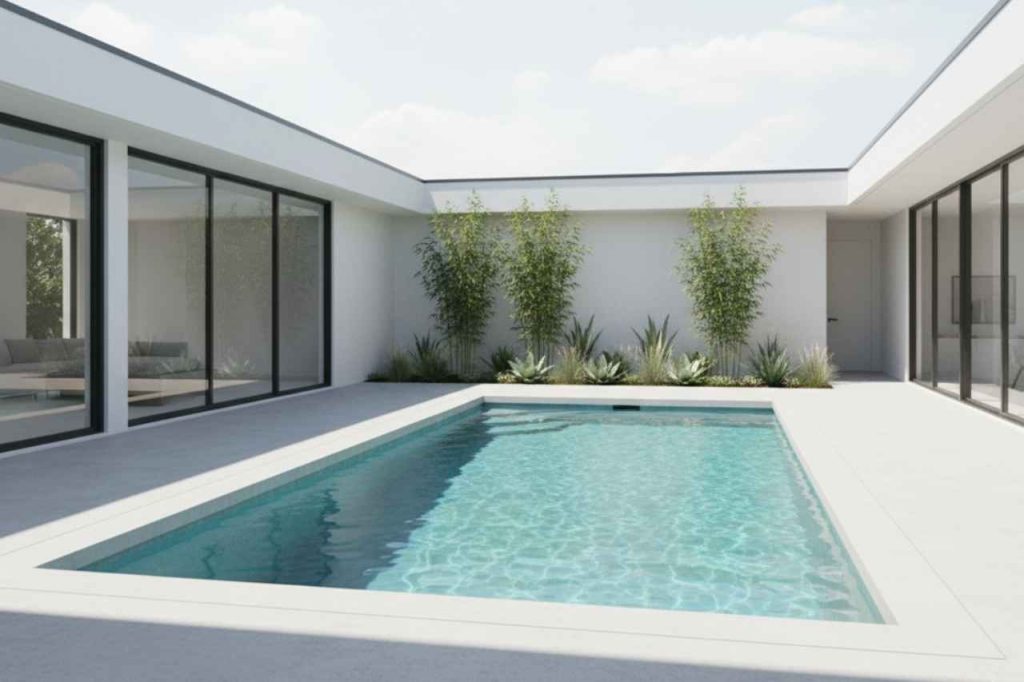
Plunge pools are smaller, steeper, and deeper than normal pools. This changes how kids fall in and climb out. While plunge pools offer a compact solution for tight sites, they require more deliberate safety planning.
If you want to understand the bigger picture beyond child safety, our complete guide to designing and installing a precast plunge pool explains how layout, depth, access, and site conditions all shape the final result.
Plunge vs Standard Pools
| Feature | Precast Plunge Pool | Standard In-Ground Pool |
|---|---|---|
| Depth | Uniform and deeper | Shallow to deep zones |
| Wall shape | Steep or vertical | Gradual slope |
| Size | Compact for small yards | Larger swim area |
| Escape options | Fewer steps or ledges | More shallow areas |
Why it matters: Fewer shallow zones mean less time to self-rescue. When space is tight, design choices must protect children from quick fall-ins and hard exits when adding a pool to a family home.
How Children Actually Get Injured in Plunge Pools
Most injuries happen through unsupervised access, sudden falls, slips, or failed self-rescue, not during planned swimming.
Top 3 causes of injury
- Unsupervised access — gates left open or climbable objects near fences.
- Sudden fall-ins — wet decks and deep edges leave no time to react.
- Self-rescue failure — steep walls or bad step design trap kids below the waterline.
Key point: It’s not a swimming skill; it’s how fast a child can enter deep water without an easy way out, even when the water temperature is comfortable.
Do plunge pools have to meet the same safety laws as full-size pools?
Yes, plunge pools must meet the same safety laws as full-size swimming pools.
In Australia, precast plunge pools are legally treated the same as any residential swimming pool, regardless of size, depth, or water volume. This applies even when plunge pools are marketed as a cost-effective solution.
To Pass Pool Safety Inspection, You Need:
- Four-sided compliant pool fencing
- Self-closing, self-latching pool gates
- Clear non-climbable zones (NCZs) around the barrier
- Safe, restricted access from the house and yard
Even above-ground plunge pools require fencing if a deck, retaining wall, or nearby structure allows a child to access the water.
What is the most important safety feature for a child-safe plunge pool?
Four-sided isolation fencing is the single best safety control. It separates the pool from the house and stops unsupervised access, ensuring your pool remains compliant as children grow.
Gate Checklist
- Self-closing and self-latching every time
- Opens outward from the pool area
- Latch height kept above small hands
Fence Type Comparison
| Type | Good Points | Watch For |
|---|---|---|
| Glass | Clear views | Gates can drop out of alignment |
| Tubular | Strong and durable | Rails spaced too wide = climbable |
| Mesh | Flexible and cost-effective | Needs tight tension and secure anchors |
If one part fails, the whole system fails.
What safety rule is most often missed in plunge pool builds?
The non-climbable zone (NCZ) is the most ignored and most failed child safety requirement.
An NCZ is a 900 mm clear space around the pool barrier where children cannot use objects to climb over. This space must stay clear at all times. It is not a suggestion. It is a legal requirement under AS 1926.
The mechanism is geometric. Children climb using reach, footholds, and leverage. The NCZ removes all three. When the space is clear, a child cannot gain height or balance to cross the fence.
Problems arise when:
- Bench seating sits too close
- BBQs, pot plants, or storage boxes creep in
- Retaining walls or steps line up with fence rails
In tight North Sydney courtyards, these items slowly turn into ladder paths that compromise safety and enjoyment. Vertical vs horizontal climb assists also matter. Horizontal rails, decorative panels, or nearby trees can provide grip. Even fence designs that look solid can fail if they offer toe holds.
Real use cases on small blocks show how easy it is to get wrong:
- A built-in deck seat becomes a step
- A pool ledge lines up with a fence rail
- A raised garden bed bridges the gap
Retrofitting an NCZ after installation is costly and frustrating. If the NCZ is broken, the barrier is broken even if the fence itself is new.
Are above-ground plunge pools safer for children?
No, above-ground and semi-above-ground plunge pools can increase certain child safety risks if access is not controlled.
Parents often assume height equals safety. In practice, elevation changes how children fall and climb, not whether they can reach the water. While precast plunge pools offer flexibility in installation height, safety controls remain mandatory.
When a plunge pool is raised:
- Fall severity increases if a child slips from a deck edge
- Deck-to-water shortcuts bypass fencing
- Retaining walls become unplanned ladders
In semi-above-ground installs, decks are commonly built right to the pool edge. If fencing is missing or poorly placed, a child can move from house to deck to water in seconds.
Comparing elevated vs ground-level pools:
- Ground-level pools rely on perimeter fencing
- Elevated pools add fall risk and require stricter access control
Elevation only improves safety when it creates offsets, moats, or isolated access points that children cannot cross. If not, fencing is still required under Australian law.
If a child can reach the pool without opening a compliant gate, the design is unsafe—regardless of height.
Which pool design features truly make a plunge pool safer for kids?
Features that support self-rescue, visibility, and calm movement reduce risk far more than decorative extras.
One of the most effective elements is a standing ledge. Unlike a narrow bench, a standing ledge lets a child place both feet flat and lift their head above water. This supports breathing and reduces panic. Benches encourage seated play but do not help a tired child climb out.
Wide, well-proportioned steps also matter. Steps should have:
- Deep treads for stable footing
- Low risers to reduce overreach
- High contrast edges for visibility
Poor step geometry can trap a child just below the waterline.
Uniform depth, common in plunge pools, needs compensation. When depth is the same everywhere, clear exits become critical. Multiple step points reduce the distance to safety.
Tanning ledges can help when they are wide, shallow, and clearly visible. Narrow shelves, however, add little safety and can create false confidence.
Designing for supervision is just as important. In tight North Sydney courtyards:
- Clear sightlines from the house
- Minimal visual clutter in the water
- Light-coloured interiors for contrast
These features help adults spot trouble early. Good design lowers panic, shortens rescue time, and supports independence as children grow.
Why do slips happen so often around plunge pools?
Because water, smooth finishes, and tight spaces combine to reduce grip, especially where children run, turn, or climb.
Top 3 Slip Zones
- Steps and benches inside the pool
- Coping edges where kids climb out
- Deck paths between the house and the pool
Prevention
- Use slip-rated tiles or textured concrete.
- Round coping edges to soften falls.
- Add lighting and colour contrast for night use.
Do pool covers make plunge pools safer for children?
Some do, but many common covers increase risk if they are mistaken for safety barriers.
Cover Comparison
| Type | Risk | Use Tip |
|---|---|---|
| Soft or solar | Can trap a child underwater | Never use as a safety barrier |
| Pool net | Reduces access but won’t stop falls | Use only as an extra safety layer |
| Weight-bearing safety cover | Blocks water access if certified | Check tension and anchors regularly |
False confidence is the real danger. Covers add layers, fencing still comes first.
Do pool alarms keep children safe?
Never replace fencing with alarms. Alarms warn after entry, not before.
There are three common types of alarms used with plunge pools:
- Immersion alarms detect movement or splashing in the water. They alert after entry, not before. In a plunge pool, the delay between entry and alarm can be very short—but still critical.
- Perimeter alarmstrigger when a boundary is crossed. These work best in larger yards. In tight North Sydney spaces, they can false-trigger often, leading families to ignore alerts.
- Door and window alarms sound when access points open. These are useful when the house forms part of the barrier, but they rely on adults responding immediately.
Best use: Combine door and immersion alarms and test regularly.
What is the most reliable way to keep children safe around a plunge pool?
Active supervision means an adult is watching the water at all times. Not nearby. Not listening. Watching. Phones, conversations, and chores pull attention away faster than most parents realise.
A simple and effective system is the “water-watcher” rotation. One adult wears a visible marker and holds full responsibility for supervision for a set time. When they hand it over, responsibility is clear. No gaps.
Practical safety supports strengthen supervision:
- CPR signage is placed near the pool
- Rescue reach poles within arm’s length
- Clear pool rules explained to children
Supervision should pause when conditions change. Alcohol, tired adults, uneven child-to-adult ratios, or busy gatherings increase risk. When focus drops, swimming stops.
The outcome for families: When supervision is clear and shared, safety improves without stress.
Can poor pool maintenance put children at risk?
Yes, unsafe water, damaged fittings, and poor storage create hidden dangers that are easy to miss.
| Problem | Risk to Kids | Fix |
|---|---|---|
| Cloudy water | Hard to see a child in trouble | Balance chemicals |
| Broken drain covers | Hair or clothing entrapment | Fit anti-entrapment grates |
| Loose chemical storage | Poisoning or burn risk | Keep chemicals locked and dry |
| Poor lighting | Trips and missteps at night | Add LED path lighting |
Check equipment often, safety systems fail quietly over time. For more information about maintenance, read our plunge pool maintenance article.
If you are still deciding between materials, our guide on the difference between precast concrete vs fibreglass plunge pools explains how each option affects maintenance, durability, drainage, and long-term ownership.
Does pool safety change after installation?
Yes, pool safety does change after installation.
Pool safety can drift over time if barriers, gates, and clear zones aren’t regularly checked and maintained.
3-Step Pool Safety Check-Up
- Test gate latches and hinges monthly to ensure they self-close and self-latch correctly.
- Keep the Non-Climbable Zone (NCZ) clear by removing plants, furniture, pots, or stored items near the fence.
- Book a professional pool safety inspection yearly or before selling your property.
How can you quickly tell if a plunge pool is child-safe?
You can quickly tell if a plunge pool is child-safe by running a simple pass/fail safety check before the pool is filled and used. If a child can reach the water without opening a compliant gate, the pool is not safe, regardless of size or depth.
Quick Pass/Fail Plunge Pool Safety Checklist
This checklist separates mandatory child safety requirements from additional safety layers that improve protection but do not replace compliance.
Must-Have Safety Requirements (Non-Negotiable)
A plunge pool should not be used if any of the following fail:
- Four-sided isolation fencing fully separates the pool from the house and yard
- Self-closing, self-latching gate that swings outward from the pool area
- The gate latch is set at the correct legal height and is functioning every time
- Clear non-climbable zones (NCZs) on all sides of the fence and gate
- Compliant drain covers and safe suction fittings to prevent entrapment
These are core requirements under Australian pool safety standards (AS 1926) and apply equally to precast plunge pools, concrete plunge pools, fibreglass plunge pools, and above-ground plunge pools.
If any one item fails, child safety compliance fails.
Helpful but Optional Safety Layers
These features do not replace fencing or gates, but they significantly reduce injury risk and improve real-world safety:
- Standing ledge or wide steps to support self-rescue
- Slip-resistant surfaces on steps, coping, and surrounds
- Adequate pool lighting for dusk or evening use
- Pool or door alarms as a secondary warning system
Think of these as risk-reduction layers, not legal protection.
The One-Question Safety Test (Before First Fill)
Before filling your plunge pool, ask:
Can a child reach the water without opening a compliant gate?
- Yes → Safety is incomplete. Do not use the pool.
- No → The pool meets the baseline access safety test.
This single question cuts through marketing claims like “small pools are safer” or “above-ground pools don’t need fencing”, which are common causes of failed inspections and serious incidents.
Conclusion
A precast plunge pool is only safe for children when all safety layers work together. Secure fencing, clear non-climbable zones, self-closing gates, self-rescue steps, and active supervision are essential. If any part fails, risk increases. Pool safety is not one product; it is a complete system.
If you are planning a family-friendly backyard, our precast concrete plunge pool solutions are designed with safety, structural strength, and practical everyday use in mind.
FAQs
1. Is my current precast plunge pool actually compliant with Australian pool safety laws (AS 1926)?
Yes, your plunge pool must comply with AS 1926, regardless of size or depth. Compliance depends on fencing, non-climbable zones, and gate function working together. Even small changes like worn latches or new furniture can break compliance. Read more about plunge pool compliant and safety rules here
2. What are the most common child safety risks inspectors find in Sydney plunge pools?
The most common risks are non-climbable zones blocked by furniture, faulty self-closing gates, and direct deck access. These issues allow unsupervised child entry, which is the primary cause of plunge pool accidents.
3. Can an existing plunge pool be made safer for young children without rebuilding it?
Yes, most plunge pools can be made safer without rebuilding. Upgrading fencing, fixing gate hardware, clearing NCZs, and improving steps or surfaces often reduces risk significantly without structural changes.
4. Do small, above-ground, or semi-above-ground plunge pools still need fencing and certification?
Yes, all plunge pools require compliant barriers and certification if a child can access the water. Elevation does not remove risk. If access exists from a deck, yard, or wall, fencing is legally required.
5. What safety features should I include if I’m planning a new precast plunge pool for a family home?
Include four-sided fencing, clear NCZs, wide self-rescue steps, slip-resistant surfaces, and strong visibility lines. These features reduce panic, support self-rescue, and make active supervision easier as children grow.
If you are ready to move from research to planning, our precast concrete plunge pool range for Sydney families shows how different layouts, finishes, and safety-focused features can be matched to your site.