At North Sydney Plunge Pools, we build high-quality precast plunge pools for small yards, sloping blocks, and tight-access homes. We give honest advice, explain each step clearly, and help homeowners choose the right installation type with confidence through a clear, expert-guided installation process.
In this guide, you’ll learn the difference between above-ground and in-ground precast plunge pools, how they’re made, what they cost, where each type works best, and the risks to avoid. By the end, you’ll know which style suits your home, your layout and your long-term plans.
What Is an Above-Ground Precast Plunge Pool?
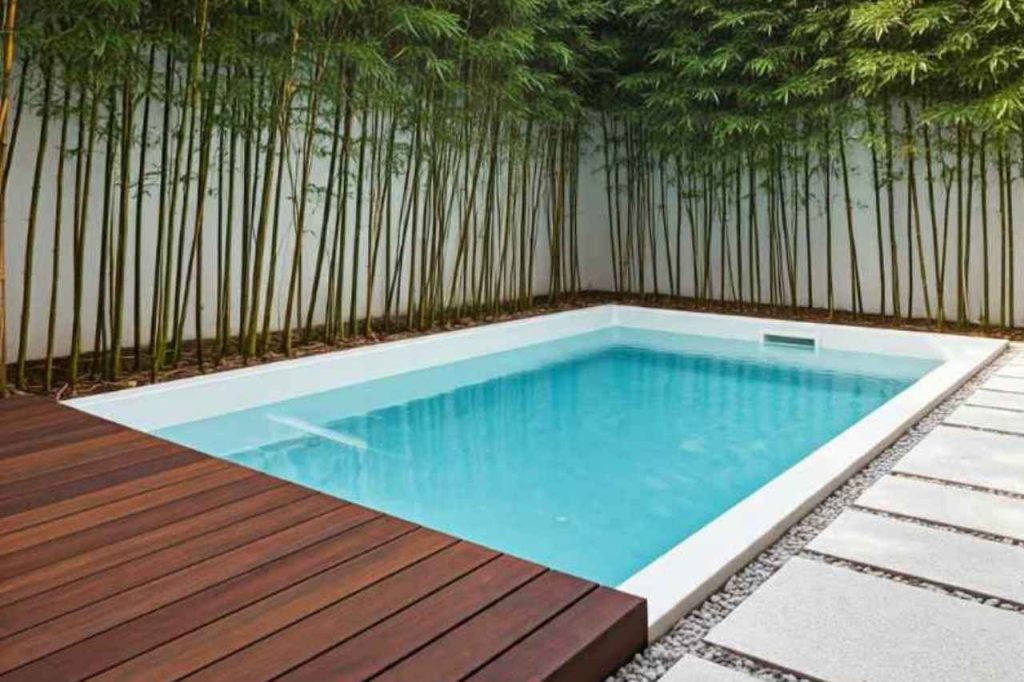
An above-ground precast plunge pool is a factory-made concrete pool that sits on top of your yard, not buried in the ground. The shell is poured, cured, and tested indoors, then lifted into place by crane and set on a strong, level base. Because there’s no digging, the install is fast, clean, and more affordable. It’s ideal for tight-access yards, rocky ground, sloping blocks, and homes where excavation is hard or too costly.
For homeowners wanting a strong, factory-built solution with faster installation, our precast plunge pool options are designed to suit compact yards, sloping sites, and tight-access Sydney homes.
What Is an In-Ground Precast Plunge Pool?
An in-ground precast plunge pool is a factory-made concrete pool that is lowered into an excavated hole so it sits flush with the ground. The shell is poured and cured in a controlled factory, then delivered by crane and set into the prepared site. This style gives a smooth, built-in look, better heat retention, and often higher long-term value. It suits flat blocks, open access yards, and homeowners wanting a seamless pool design.
Above-Ground vs In-Ground: Core Comparison
In the quiet geometry of a backyard, even a small pool can reshape the way space, gravity, and time feel. Above-ground, in-ground, and semi-in-ground precast plunge pools are simply different ways of placing the same engineered shell into the environment but each choice sets off its own chain of outcomes.
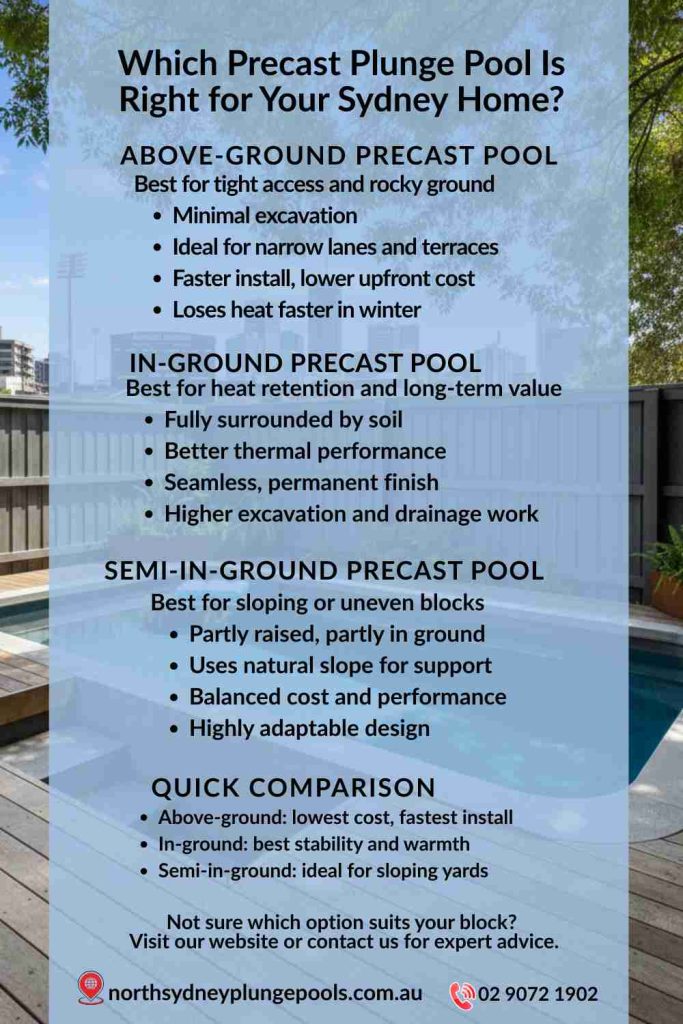
Above-Ground Precast Plunge Pools
Above-ground precast plunge pools rise above the soil like a suspended platform. Without excavation, they avoid the energy-heavy work of digging and spoil removal. This makes them the most affordable and fastest installation option, ideal for tight-access homes, rocky terrain, and sloping blocks where machinery struggles. Their exposed form also makes maintenance easier, as pumps and pipes remain within reach.
In-Ground Precast Plunge Pools
In-ground precast plunge pools, buried within an excavated cavity, behave more like a structure integrated into the earth itself. This gives them a seamless, built-in finish and higher long-term value. Their thermal performance changes too, the surrounding soil acts as an insulating layer, helping the water stay warmer for longer. These pools demand more upfront work, more engineering, and more cost, but the final result feels timeless and naturally connected to the landscape.
Semi-In-Ground Precast Plunge Pools
Semi-in-ground precast plunge pools occupy the in-between: half raised, half embedded. This hybrid design works with the physics of sloping blocks, allowing the shell to rest partly in the ground while still keeping part of its walls visible. Costs sit in the middle, as the excavation is lighter and the structural support more flexible. It’s the practical answer when your yard has uneven levels but you still want a stylish, modern pool.
Which type is better?
There is no single “best” design.
- Above-ground pools maximise speed and affordability.
- In-ground pools optimise beauty, performance, and long-term property value.
- Choose semi-in-ground if your yard slopes or you want a balanced mix of style, support, and cost.
The best choice depends on the shape of your land, the conditions beneath your feet, and the future you imagine for your outdoor space.
And if you’re also weighing up shell materials, our guide to precast concrete and fibreglass plunge pool differences explains how they compare for strength, lifespan, heat retention, and installation control.
Quick Comparison
| Feature | Above-Ground | In-Ground | Semi-In-Ground |
|---|---|---|---|
| Cost | Lowest (no digging) | Highest (excavation + drainage) | Mid-range |
| Install Speed | Fastest (1–2 days) | Slowest (1–2 weeks) | Medium |
| Durability | Very strong but exposed | Strong, soil-protected | Strong with some support |
| Look | Modern, raised | Seamless, built-in | Stylish raised edge |
| Maintenance Access | Easy | Harder (buried pipes) | Medium |
| Best For | Tight or rocky yards | Flat, open yards | Sloping sites |
| Thermal Efficiency | Loses heat faster | Holds heat longer | Middle ground |
| Property Value | Moderate | Higher | Depends on the finish |
If installation speed is a major factor for your project, our guide to how long it takes to build a plunge pool in Sydney explains what happens from approvals and site prep through to handover and swim-ready sign-off.
Durability & Strength
When you place a precast plunge pool into a backyard, you aren’t just choosing a shape or a colour, you’re choosing how the shell will interact with the unseen forces around it: pressure, heat, vibration, soil movement, and time. Each installation style; above-ground or in-ground creates its own small universe of behaviour.
Above Ground
An above-ground precast plunge pool stands free from the earth, held steady by engineered footings and wind bracing. Its walls face the open air, experiencing less soil pressure but more exposure to the forces around it.
Inground
In-ground precast pool becomes part of the landscape itself. The surrounding soil behaves like a gravitational field, pressing evenly against the shell and providing natural stability.
Maintenance
Above-ground
When the shell is raised above the ground, maintenance becomes a simple act: pumps, heaters, and pipes sit in plain reach, like instruments laid out on a table.
In-ground
An in-ground system hides its components, creating a cleaner aesthetic but requiring more planning when repairs arise.
For more information how to maintain your plunge pool, visit our plunge pool maintenance article
Aesthetic & Design
Above Ground
Viewed from above, an above-ground precast pool resembles a raised platform, ready to be wrapped in decking, screens, and lighting. Its form becomes part of the architecture.
Inground
An in-ground pool is the opposite: a smooth, seamless cut into the landscape, blending with stone, grass, and the natural geometry of the yard.
Thermal Performance
Above-ground pools lose warmth faster as their exposed walls release energy into the air. Add insulation panels, and you slow this escape. In-ground pools, embraced by soil, retain heat much like a planet holds warmth beneath its crust.
Noise & Vibration
Above-ground shells may carry more vibration, but simple tools like rubber pads, acoustic liners, careful footing, dampen the noise. In-ground shells, surrounded by dense soil, absorb energy quietly.
Site Preparation for Above-Ground Precast Plunge Pools
Preparing your yard for an above-ground precast plunge pool is simple, but the base needs to be strong and level so the shell stays safe and stable. Here’s what you need to check before the pool arrives.
1. Check Delivery Access
A truck and crane must reach your yard safely. The installer checks:
- driveway width
- tight corners
- overhead power lines
- room for the crane to set up
Good access helps place the shell smoothly.
2. Test the Soil
Even above-ground pools need a stable base. The team checks:
- soil type (hard soil, clay, sand)
- soft spots that need extra support
- ground slope and water flow
Clay or sandy soil may need extra compaction so the pool doesn’t move.
3. Build a Strong Base
Above-ground shells sit directly on a prepared footing. Most sites need:
- compacted road base
- a level concrete pad (for some models)
- rubber pads to reduce vibration and noise
A flat base stops the pool from leaning or shifting during storms or heavy use.
4. Plan Drainage Around the Pool
Even raised pools need good water flow around the shell. Installers check:
- stormwater path
- sloping away from the pool
- gravel or strip drains for wet areas
This keeps the ground firm during rainfall.
5. Map Utilities
Before placing the pool, the team checks for:
- buried pipes (water, sewer, stormwater)
- electrical cables
- gas lines
Power must also be ready for pumps, heaters, or lights.
Why It Matters
A safe above-ground install depends on:
- solid footing
- correct compaction
- clean access
- good drainage
These steps keep the pool stable and protect it from shifting, cracks, or leaks.
Site Preparation for In-Ground Precast Plunge Pools
In-ground precast plunge pools need more work because the shell is lowered into an excavated hole. Proper preparation stops movement, handles soil pressure safely, and protects the pool for decades.
1. Soil Testing and Geotechnical Checks
Installers test the soil to understand:
- soil class (A, M, H)
- clay expansion
- sand softness
- rock layers
This helps design the right excavation depth and support.
2. Excavation and Ground Shaping
The hole must be:
- dug to the exact length, width and depth
- level across the base
- large enough for drainage layers
- clear of tree roots and soft patches
Rocky sites may need extra machinery or cutting tools.
3. Drainage and Base Construction
In-ground pools rely heavily on correct drainage. Installers add:
- gravel bedding
- stabilised sand
- strip drains
- ag drains around the shell
This moves water away from the walls and stops soil pressure building up.
4. Access for the Crane Lift
The crane must lift the shell over the house or through the side yard. Checks include:
- lift distance
- weight of the concrete shell
- power line clearance
- safe landing zone
Poor planning here causes delays or failed installation days.
5. Map Underground Services
Before digging, the team checks for:
- sewer lines
- stormwater drains
- gas and electrical services
- NBN conduits
This prevents damage and helps plan the pump location.
6. Backfilling and Compaction
After the shell is lowered in:
- the gap around the pool is filled with gravel
- layers are compacted evenly
- soil is checked for movement
Even compaction stops the shell from twisting or settling over time.
7. Engineering and Council Rules
Some homes need:
- Complying Development Certificate (CDC)
- Structural engineer sign-off
- Drainage plans
- Fencing compliance
This keeps the installation legal and safe.
Why It Matters
An in-ground precast pool relies on:
- correct excavation
- strong drainage
- stable soil
- safe backfilling
These steps protect the shell from soil pressure, cracking, water buildup, and long-term movement.
Common Problems to Avoid For Above Ground
An above-ground precast plunge pool behaves like a floating structure resting on the thin boundary between earth and air. Its stability depends not on the soil holding it in place, but on the precision of the platform beneath it and the forces that act upon its exposed walls. Most problems arise when these forces are underestimated.
1. Uneven or Soft Base
Just as a planet tilts when its core is unstable, a pool will lean if the base beneath it settles or shifts. Poor compaction or soft soil lets gravity reshape the platform over time.
2. Poor Drainage Around the Shell
Water collects, the soil weakens, and the ground loses its strength. Without a clear path for stormwater, the base behaves like soft mud under pressure.
3. Not Enough Wind Bracing
Raised walls catch wind like sails. Without bracing, even small gusts create micro-movements that build into long-term instability.
4. Tight Delivery Access
If the crane cannot find a safe arc or the truck cannot enter the driveway, the installation becomes a problem of geometry and clearance rather than construction.
5. Exposed Plumbing and Pumps
Without insulation or acoustic pads, vibration travels through the shell like waves through a medium—small, but noticeable.
6. Poor Load Support on Slopes
Gravity acts unevenly on sloping ground. A raised platform without extra support behaves like an object resting on a tilted plane—always seeking a lower point.
7. Decking That Traps Water
Moisture caught between the deck and the shell forms a micro-climate that softens the base and accelerates decay.
8. No Clearance for Servicing
When machines lack space, repairs become difficult, and the system loses predictability, much like trying to fix a satellite without room to manoeuvre.
9. Wrong Pump or Filter Size
Equipment mismatches create inefficiencies, like running a small engine to power a large spacecraft.
10. No Noise Control
Vibrations ripple through the structure. Without rubber feet or pads, energy moves freely and becomes sound.
Check out our latest case study on how we handle above ground installation.
Common Problems to Avoid For Inground
In-ground installations act like structures embedded within a gravitational field. Most failures come from changes in that field or from miscalculations of the forces that surround the shell.
1. Incorrect Excavation Depth or Shape
If the cavity is uneven, the shell cannot sit as the engineers intended. A pool placed on an imperfect foundation behaves like a planet whose orbit has been disturbed always slightly off balance.
2. Poor Backfilling
Loose gravel or un-compacted soil leaves voids that collapse slowly over time, pulling the shell with them. Stability requires density, just as stars require mass to maintain form.
3. No Perimeter Drainage
Water trapped around the walls increases hydrostatic pressure. The earth presses inward, and the shell must resist forces it was not meant to bear.
4. Hitting Underground Services
Striking unseen pipes or cables interrupts the hidden network beneath the home, a reminder that beneath every surface lies a complex system waiting to be mapped.
5. Poor Stormwater Planning
Rainwater flows downhill with absolute obedience to gravity. If the site does not guide it away, the excavated hole becomes a basin, softening the base and changing the soil’s behaviour.
6. Damaged Waterproof Membrane
Backfill friction or sharp stones can cut the protective coating. Even a small breach lets water migrate through the concrete, much like a crack in a vessel that slowly leaks over time.
7. Incorrect Shoring on Slopes
On a steep block, soil pressure acts more heavily on one side. Without proper retaining or support, the shell becomes the point where gravity’s uneven pull meets structural resistance.
8. Misaligned Crane Lift
Every lift is a problem of trajectory. When distance, weight, and swing radius are misjudged, the entire operation becomes unsafe, much like a spacecraft entering the wrong orbit.
9. Equipment Mismatch
Filters, heaters and pumps that don’t match the pool’s volume cause inefficiencies much like a star burning too fast or too slow for its size.
10. Non-Compliance With Council Rules
Even physical systems must follow laws, here, not of physics, but of safety and regulation. When ignored, progress stops, inspections fail, and the project stalls.
Quick Decision Guide
Choosing between an above-ground, in-ground, or semi-in-ground precast plunge pool is easier when you look at your budget, the shape of your yard, and the climate in your area. Each installation style behaves differently depending on your soil, access, and long-term plans.
Below is a simple guide to help you decide what works best for your home in Sydney.
Above Ground Precast Pool
In an above-ground precast plunge pool, the shell sits freely above the soil, supported only by its engineered base. It is the lightest option in terms of work and energy, avoiding the excavation that changes the terrain. It suits tight-access terraces, rocky ground, and the narrow lanes found across Sydney’s older suburbs. Its raised form makes it easy to maintain, but its walls release heat to the winter air faster, just as small planets lose warmth in the coldness of space.
Inground Precast Pool
An in-ground precast plunge pool, by contrast, becomes part of the earth. Soil surrounds the shell like a thermal blanket, keeping the water warmer during Sydney’s cooler winters. This is why in-ground designs perform best in leafy, cooler suburbs where evening temperatures drop. The excavation and drainage work demand more effort, but the reward is a seamless permanent structure that adds long-term value, much like an object that has settled into a stable orbit.
Semi-inground Precast Pool
A semi-in-ground precast plunge pool sits between these two states, partly raised, partly embraced by soil. This balanced configuration is ideal for Sydney’s sloping blocks, where the terrain itself guides the engineering. It combines the physics of soil support with the ease of access of a raised shell, making it the most adaptive choice for uneven land.
Your budget, yard shape, soil class, and long-term plans all behave like variables in a simple equation.
- Above-ground pools minimise cost and energy.
- In-ground pools maximise stability, heat retention, and property value.
- Semi-in-ground pools balance the geometry of sloping yards with structural support.
The right choice is the one that aligns your land’s natural forces with the future you imagine for your outdoor space. When these elements come into harmony, the result is not just a pool but a stable, predictable, and beautifully integrated system.
Conclusion
Choosing between an above-ground, in-ground or semi-in-ground precast plunge pool becomes much easier when you understand your yard, your budget and the look you want. Each style has its own strengths, and the right one depends on how you plan to use your space.
Above-ground pools suit tight access, rocky yards and fast installs. In-ground pools give the cleanest, most seamless finish and can add strong long-term value. Semi-in-ground pools work best on slopes or when you want a mix of raised and built-in design. No matter the choice, a precast shell gives you strong concrete, fast installation and a modern, durable pool for everyday use.
If you’re ready to explore the right option for your site, our precast concrete plunge pool range in Sydney gives you a closer look at available styles, features, and installation suitability.
Ready to start your project? Contact our team and get friendly, expert help choosing the right precast plunge pool for your home.
FAQs
1. How do I know if my yard is better suited for an above-ground or an in-ground precast plunge pool?
Your yard suits an above-ground pool if digging is hard, space is tight, or the block is sloped. It suits an in-ground pool if the land is flat and you want a smooth, built-in look. The choice shapes how your backyard behaves under gravity, time and use.
2. What is the full cost difference between above-ground, in-ground and semi-in-ground precast pool installations?
Above-ground pools cost the least, in-ground pools cost the most, and semi-in-ground pools sit in the middle. The difference comes from digging, soil removal and engineering. Like the universe, each option follows its own rules of energy, effort and long-term reward.
3. Do I need council approval for above-ground and in-ground precast pools in Sydney?
Yes, most Sydney pools need council approval, especially in-ground designs. Above-ground pools may qualify for fast-tracked checks, but safety fencing and rules always apply. Think of it as aligning your pool with the laws that keep homes safe and orderly.
4. What type of site preparation is required for each installation style?
Above-ground pools need a strong, level base. In-ground pools need digging, soil testing and backfilling. Semi-in-ground needs a shallow cut and support on the raised side. Good preparation is like good physics; strong foundations create stable, predictable outcomes.
5. Will an above-ground pool look as good as an in-ground one once the landscaping is added?
Yes, an above-ground pool can look just as good with the right decking, screens and lighting. Design can hide the height and shape the space. With thoughtful planning, beauty like gravity flows through structure, balance and simple choices.